


EquityTool: Update released October 14, 2025
The EquityTool has been updated based upon new source data. The original version is no longer active but is available upon request.
Previous version released: November 13, 2019
Source data: Ghana DHS 2022
# of survey questions in original wealth index: 45
# of variables in original index: 171
# of survey questions in EquityTool: 9
# of variables in EquityTool: 11
Questions:
| Option 1 | Option 2 | Option 3 | ||
| Q1 | Does your household have a refrigerator? | Yes | No | |
| Q2 | Does your household have a cabinet? | Yes | No | |
| Q3 | Does your household have a television? | Yes | No | |
| Q4 | Does any member of yourhousehold own a watch? | Yes | No | |
| Q5 | Does any member of thishousehold have an accountin a bank or other financialinstitution? | Yes | No | |
| Q6 | What is the main source ofdrinking water for members ofyour household? | Sachet water | Other | |
| Q7 | In your household, what typeof cookstove is mainly used forcooking? | Three stone/ open fire | Liquefied Petroleum Gas (LPG)/cooking gas stove | Other |
| Q8 | What type of fuel or energysource is used in thecookstove? | Wood | Other | |
| Q9 | What is the main material ofthe floor of your dwelling? | Ceramic/Marble/Porce lain/Tiles/Terrazo | Cement | Other |
Technical notes:
The standard simplification process was applied to achieve high agreement with the original wealth index. Kappa was greater than 0.75 for the national and urban indices. Details on the standard process can be found in this article. The data used to identify important variables comes from the factor weights released by ICF.
Level of agreement:
National Population (n=17,933) | Urban only population (n=8,795) | |
| % agreement | 85% | 85% |
| Kappa statistic | 0.77 | 0.76 |
Respondents in the original dataset were divided into three groups for analysis – those in the 1st and 2nd quintiles (poorest 40%), those in the 3rd quintile, and those in the 4th and 5th quintiles (richest 40%). After calculating their wealth using the simplified index, they were again divided into the same three groups for analysis against the original data in the full DHS. Agreement between the original data and our simplified index is presented above.
What does this mean?
When shortening and simplifying the index to make it easier for programs to use to assessequity, it no longer matches the original index with 100% accuracy. At an aggregate level, thiserror is minimal, and this methodology was deemed acceptable for programmatic use by anexpert panel. However, for any given individual, especially those already at a boundary betweentwo quintiles, the quintile the EquityTool assigns them to may differ to their quintile according tothe original DHS wealth index.
The graph below illustrates the difference between the EquityTool generated index and the fullDHS wealth index. Among all of those people (20% of the population) originally identified asbeing in the poorest quintile, approximately 70% are still identified as being in the poorestquintile when we use the simplified index. However, approximately 27.5% of people are nowclassified as being in Quintile 2. From a practical standpoint, all of these people are relativelypoor. Yet, it is worthwhile to understand that the simplified index of 9 questions produces resultsthat are not identical to using all 45 questions in the original survey.
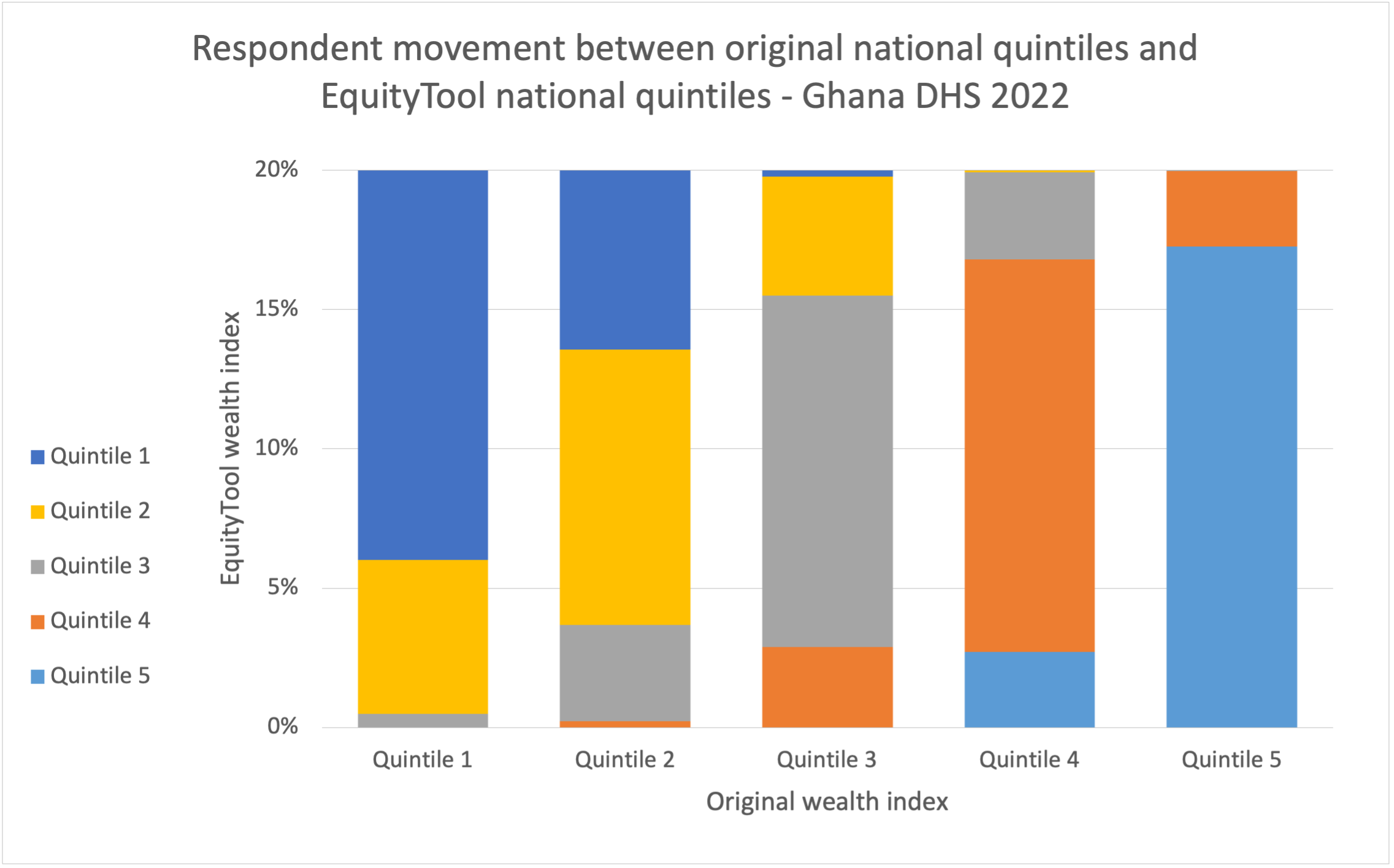
The following table provides the same information on the movement between national quintiles when using the EquityTool versus the original DHS wealth index:
| EquityTool National Quintiles | |||||||
| Quintile 1 | Quintile 2 | Quintile 3 | Quintile 4 | Quintile 5 | Total | ||
| Original DHS National Quintiles | Quintile 1 | 14.0% | 5.5% | 0.5% | 0.0% | 0.0% | 20% |
| Quintile 2 | 6.4% | 9.9% | 3.4% | 0.2% | 0.0% | 20% | |
| Quintile 3 | 0.2% | 4.3% | 12.6% | 2.9% | 0.0% | 20% | |
| Quintile 4 | 0.0% | 0.1% | 3.1% | 14.1% | 2.7% | 20% | |
| Quintile 5 | 0.0% | 0.0% | 0.0% | 2.7% | 17.3% | 20% | |
| Total | 20.6% | 19.7% | 19.7% | 19.9% | 20.0% | 100% | |
The following graph provides information on the movement between urban quintiles when using the EquityTool versus the original DHS wealth index:
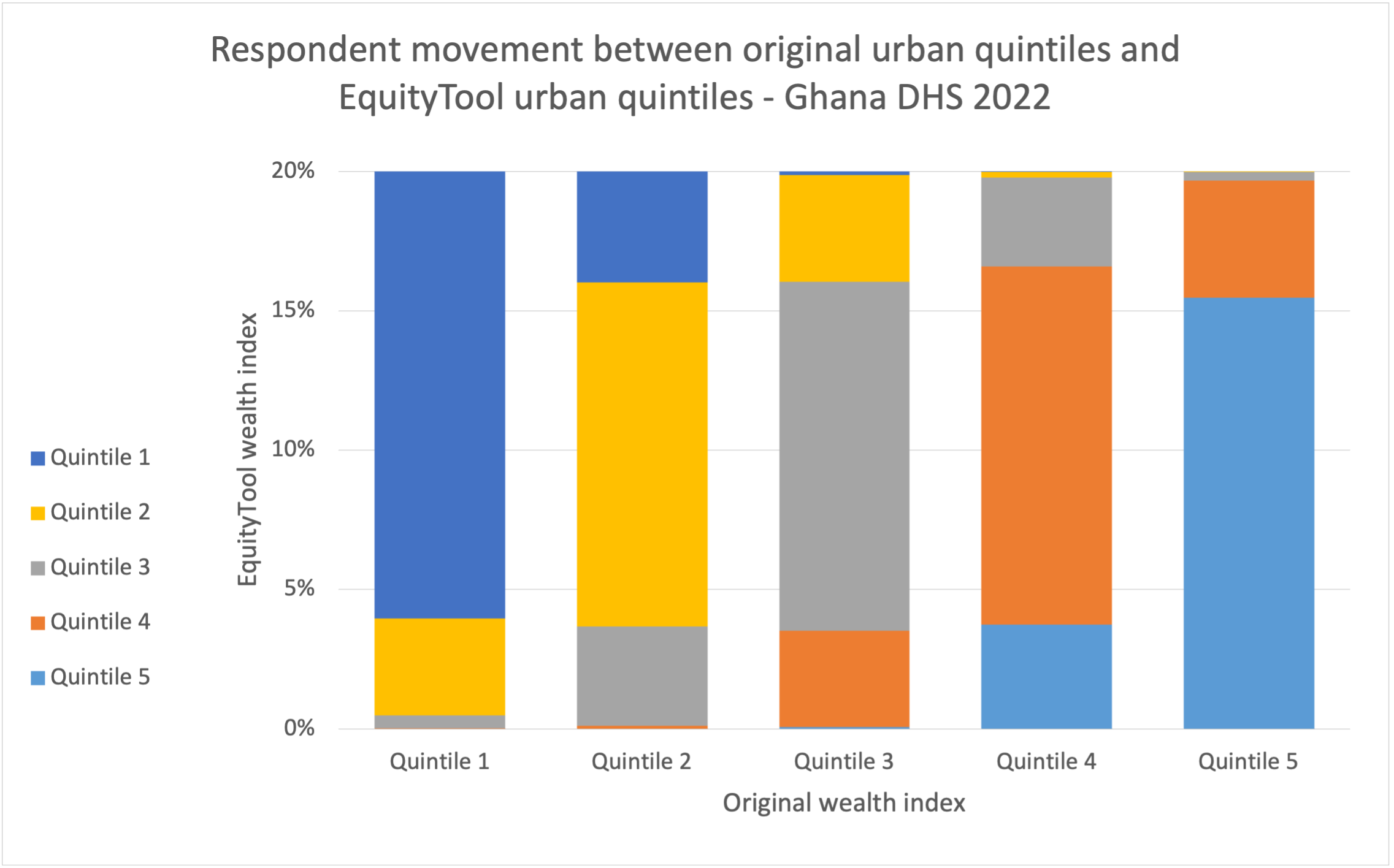
The following table provides the same information on the movement between urban quintiles when using the EquityTool versus the original DHS wealth index:
| EquityTool Urban Quintiles | |||||||
| Quintile 1 | Quintile 2 | Quintile 3 | Quintile 4 | Quintile 5 | Total | ||
| Original DHS Urban Quintiles | Quintile 1 | 16.0% | 3.5% | 0.5% | 0.0% | 0.0% | 20% |
| Quintile 2 | 4.0% | 12.3% | 3.6% | 0.1% | 0.0% | 20% | |
| Quintile 3 | 0.1% | 3.8% | 12.5% | 3.4% | 0.1% | 20% | |
| Quintile 4 | 0.0% | 0.2% | 3.2% | 12.8% | 3.7% | 20% | |
| Quintile 5 | 0.0% | 0.0% | 0.3% | 4.2% | 15.5% | 20% | |
| Total | 20.2% | 19.9% | 20.0% | 20.6% | 19.3% | 100% | |
Data interpretation considerations:
- This tool provides information on relative wealth – ‘ranking’ respondents within the national or urban population. The most recent available data from the WorldBank indicates that 39.03% of people in Ghana live below $3.00/day[1]. This information can be used to put relative wealth into context.
- People who live in urban areas are more likely to be wealthy. In Ghana, 33% of people living in urban areas are in the richest national quintile, compared to only 5% of those living in rural areas[2].
- If your population of interest is predominantly urban, we recommend you look at the urban results to understand how relatively wealthy or poor they are, in comparison to other urban dwellers.
- If the people you interviewed using the EquityTool live in rural areas, or a mix of urban and rural areas, we recommend using the national results to understand how relatively wealthy or poor they are, in comparison to the whole country.
- Some regions in Ghana are wealthier than others. It is important to understand the country context when interpreting your results.
- In most cases, your population of interest is not expected to be equally distributed across the five wealth quintiles. For example, if your survey interviewed people exiting a shopping mall, you would probably expect most of them to be relatively wealthy.
Changes from the previous EquityTool
We released an EquityTool on November 13, 2019, which compared user data to a benchmark of 2017. A new source survey, the Ghana DHS 2022 was recently released, and allows us to benchmark results to a more recent population. This is important, because wealth generally increases over time, and comparing your respondents to an old benchmark population will lead to over-estimating the relatively wealthy in your survey. The new EquityTool was generated using the exact same methodology as the previous version, and in generating the new EquityTool, no attempt was made to account for the fact that a previous version existed. In other words, we did not explicitly try to keep the same questions or response options as the previous tool.
Practical Considerations
For those who have not previously conducted an EquityTool based study in Ghana, the remainder of this section is not particularly relevant. For those who have used the previous EquityTool, you may be interested to know how the two versions compare.
| Previous | Current | |
| Source Data | 2017 MHS | 2022 DHS |
| # of questions in EquityTool | 11 | 9 |
| # of questions in full wealth index | 33 | 45 |
| # of variables in EquityTool | 12 | 11 |
| # of variables in full wealth index | 115 | 171 |
| Kappa statistic (EquityTool vs full wealth Index) for 3 groups | National 0.76 Urban 0.75 | National 0.77 Urban 0.76 |
Compared to the previous EquityTool some of the questions and variables included have changed.
The previous EquityTool included 12 variables. Of those 12 variables, 8 are still included in the current EquityTool.
- Refrigerator
- Cabinet
- Television
- Watch
- Bank account
- Drinking water: Sachet water
- Cooking fuel: wood
- Floor material: cement
Three variables are included in the new EquityTool that were not included in the previous EquityTool.
1. Cooking stove: three stone/ open fire
2. Cooking stove: Liquefied Petroleum Gas
(LPG)/cooking gas stove
3. Floor material:
Ceramic/Marble/Porcelain/Tiles/Terrazzo
It is generally best to use the current version of the EquityTool, since it will give a more accurate quintile estimates. If you are currently collecting data, it is best to continue to use the previous tool. Note that if you have created a survey in the EquityTool web application using the previous EquityTool, that survey will continue to use the previous EquityTool.
If conducting a follow-up survey to a baseline that used the previous EquityTool, and the most important result is change from the baseline, it may be preferable to continue to use the previous EquityTool for comparability. If you need to do this, please contact us at support@equitytool.org.
Contextualizing Changes in the EquityTool
Comparing the results of surveys that used the previous EquityTool against those that use the current EquityTool is difficult. It will not always be clear whether any difference is because of actual differences in the wealth level of the respondents or because the EquityTool has changed.
The section below provides relevant contextual information that may help a user understand why the EquityTool has changed from the previous tool.
Changes in Asset Ownership
Over time, patterns of asset ownership change. This may reflect the fact that an asset which previously was quite expensive has become more affordable over time, making it more accessible to a large population or that the population has grown wealthier and now a larger portion of the population is able to afford more expensive goods. Likewise, some assets may simply become more or less prevalent due to technological changes. As asset ownership patterns change, their ability to help us distinguish between wealth quintiles may also change.
In Figure 1 we show how ownership of the assets in the original benchmark survey and the current benchmark survey have changed [2]. Variables that are not included in both DHS surveys are not shown in this graph. Assets in red appear in both the current and previous versions of the EquityTool.
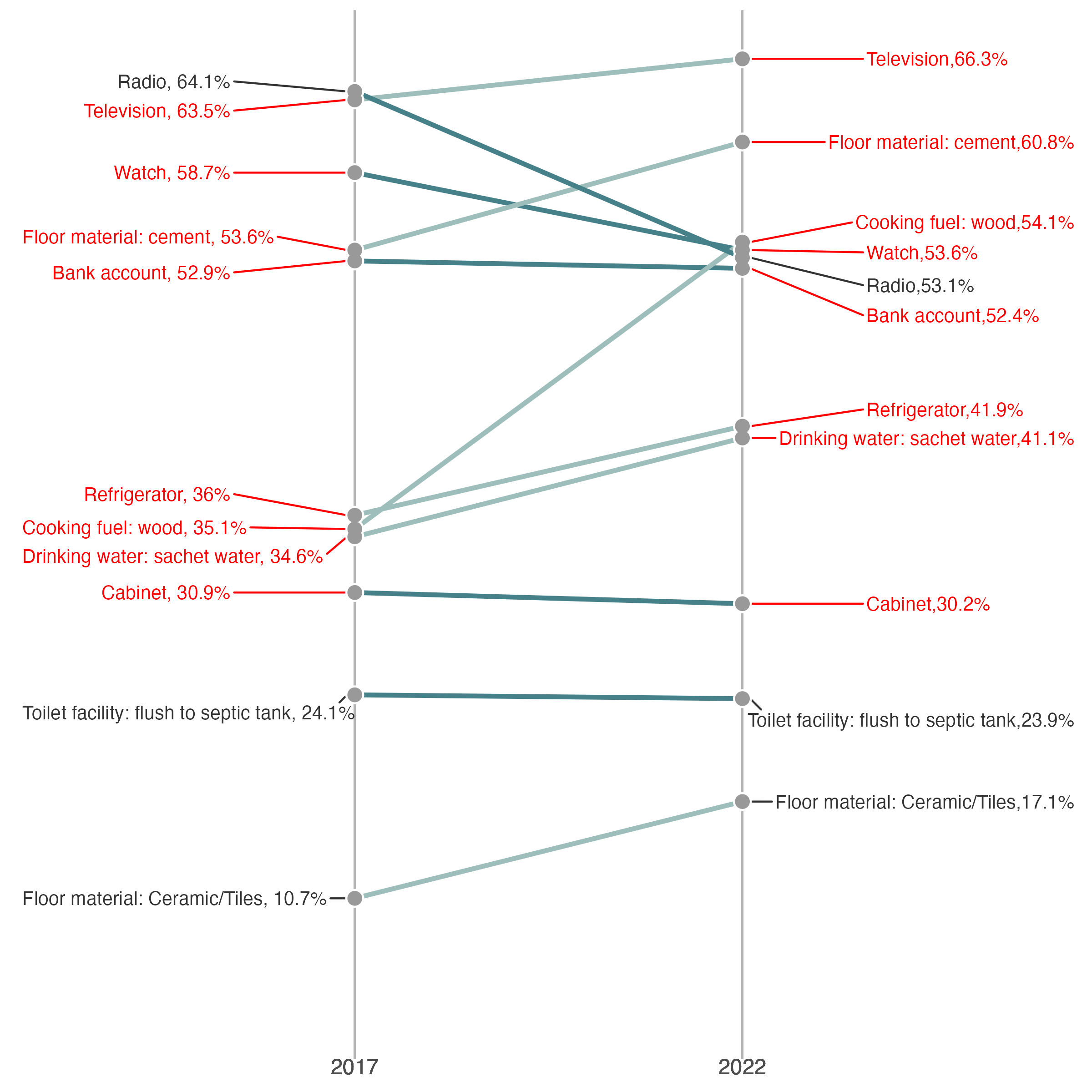
Between 2017 and 2021, there were some notable changes in Ghana’s asset ownership rates. For example, the percentage of households using wood for cooking fuel increased by 19 percentage points. However, the percentage of households with a radio declined by 11 percentage points.
Changes in Country Context
Changes in the EquityTool often reflect changes in the economic well-being of the population. As the population wealth changes, the prevalence of different assets may change.
The following table provides a summary of some key indicators that illustrate how the economic well-being of the population of Ghana has changed from 2017 to 2022
| Previous Survey: MHS 2017 | Current Survey: DHS 2022 | |
| Percent of the population living below the poverty line [1] | 41.77 (2012) | 39.03% (2016) |
| Percent of the population that is multidimensionally poor [3] | 24.70% | 21.3% |
| GDP per capita [4] | 59946728 | 6728 |
| Average annual GDP growth from 2017 to 2022 [5] | 5.04% | |
The Ghanaian economy grew between 2017 to 2022. Accompanying this economic growth has also been a decrease in the poverty headcount as measured by both the international poverty line and the Multidimensional Poverty Index. This economic improvement, over time, will reduce the previous Ghana EquityTool’s ability to accurately assign households to their most correct wealth quintiles.
Metrics for Management provides technical assistance services to those using the EquityTool, or wanting to collect data on the wealth of their program beneficiaries. Please contact support@equitytool.org and we will assist you.
[1] From pip.worldbank.org, reporting poverty headcount ratio at $3.00/day at 2021 international prices.
[2] From the Ghana dataset household recode, available at http://dhsprogram.com/
[3] From Oxford Poverty and Human Development Initiative (October 2024). “Ghana Country
Briefing”, Oxford Poverty and Human Development Initiative, University of Oxford.
[4] From data.worldbank.com, reporting GDP per capita, PPP (constant 2021 international $)
[5] From data.worldbank.com, reporting average of GDP growth (annual %)
