Prize Information

Davidson Gwatkin Equity Catalyst Award

Metrics for Management, with support from the Broad Reach Foundation and Nepheli Foundation, is pleased to announce the 2026 Davidson Gwatkin Equity Catalyst Award. The Equity Catalyst Award, first introduced in 2024, supports future applications of the EquityTool and its data to assess and improve services that reach the poor or to gain insight into wealth equity in low- and middle-income countries.

This year, Metrics for Management (M4M) is pleased to introduce a second theme of the Equity Catalyst Award recognizing innovative future equity measurement projects in humanitarian contexts. M4M is currently expanding its suite of measurement resources by developing tools specifically designed to respond to equity measurement needs in humanitarian settings globally.

Applicants must be attending the 2026 Global Symposium on Health Systems Research in Cairo, Egypt (December 7-9, 2026) to be eligible to apply. Up to 10 applicants will be selected to give a 4-minute lightning talk at an M4M-sponsored side session. The audience will vote on four winners across both Equity Catalyst Award themes, who each will be awarded $1000.

Practitioners, students, postdoctoral scholars, and faculty are eligible to participate, and applications may be submitted either by an individual author or a team of co-authors.

Application forms for the Equity Catalyst Award will be open from September 21 to October 2, 2026.

About Davidson Gwatkin

Davidson (Dave) Gwatkin is a leading global voice on how to apply pro-poor policies and programs to make health systems more equitable and advance progressive universalism. As an advisor to the World Bank, the African Development Bank, WHO, UNICEF, the Rockefeller Foundation, and other agencies, he has worked to assure that the poor are the focus of development efforts and that they remain at the center of measuring development success. In doing so, he has inspired two generations of experts in health, agriculture, education, and economics, guiding them to understand that development success should be measured by the effects on individuals and families, not on national statistics. In addition, Dave champions measurement as central for all development work and believes that the measurement of wealth can play an important role in all equity-focused efforts. He has advised the development of the EquityTool since 2010, and has served as a Global Advisor to Metrics for Management since 2015. With Dave’s help, the EquityTool has grown into an efficient and valid tool, easy and fast enough to serve the needs of a national government, international donor, or local school, NGO, or clinic.
Themes

Applicant proposals may respond to one of two themes:  

Theme 1: Development Equity Measurement
Proposes program, service delivery, or research uses of M4M’s EquityTool to assess and improve health services for populations in low- and middle-income countries. Submissions must propose to collect or apply EquityTool data within the next two years.

See 2024 Equity Catalyst Award winners here.

Theme 2: Humanitarian Equity Measurement
Proposes innovative projects measuring equity in humanitarian health service delivery, including but not limited to applications of emerging tools or practices. This category welcomes submissions exploring the conceptualization of equity in crisis-affected populations, validating measures of equity, or testing or refining data collection and research implementation methods in humanitarian settings. Submissions must propose to collect data or apply the measurement method within the next two years.

Application Steps

  • Applications must be submitted through the application portal by the deadline of 11:59 pm ET on October 2, 2026. To be considered for the Award, applicants should submit a brief proposal in response to one of the two themes.  
  • Only one submission per project is permitted, and nominees may apply to only one of the two themes. Multiple applications may result in disqualification for all applicants.


Eligibility Criteria

Applicants

  • Author or co-author of a proposed study or implementation project that meets the eligibility criteria (below) for one of the two award themes.
  • Applicant must have a demonstrated organizational affiliation. Either:
    • Full-time staff at a public or private organization such as a government agency, non-governmental agency, or technical firm. Independent contractors are not eligible unless the contractor can demonstrate a dedicated and prolonged relationship with the organization through a contract of, or series of contracts totaling, at least one year of continuous engagement. 
    • A student, postdoctoral scholar, or faculty affiliated with a university or similar research organization.
  • Applicant has not received, or been part of a team that has received, a Davidson Gwatkin Equity Measurement Prize or Equity Catalyst Award in previous submission cycles.
  • Applicants representing collective work must certify that all team members or co-investigators support the submission at the time of application.
  • Applicant, or a representative from their team, will attend the Global Symposium on Health Systems Research in Cairo, Egypt (December 7-9, 2026) to present a 4-minute lightning talk in-person at M4M’s conference side session. Presentations will follow the template provided by Metrics for Management, and must be delivered in English.
  • Applicant will participate in promotional activities related to your submission, as requested by Metrics for Management. Examples may include social media posts, interview, and/or written case study.
  • Winners are responsible for prize receipt and management, as well any applicable taxes.

Proposed Work

Theme 1: Development Equity Measurement:

  • Primary data collection and/or application of the EquityTool questions planned to take place between January 1, 2027 – December 31, 2028. 
  • Provides a clear implementation link for why wealth measurement is important, and why the EquityTool is the best solution to better target or serve the poor with health services. 
  • Work can be made publicly available.
  • Proposal must be submitted in English.

Theme 2: Humanitarian Equity Measurement:

  • Primary data collection and/or application of the equity measurement method planned to take place between January 1, 2027 – December 31, 2028. Provides a clear description and rationale for how the conceptualization of equity and the proposed data and analysis methods can be used to better inform response and guide resources in humanitarian and/or conflict settings.
  • Work can be made publicly available. 
  • Proposal must be submitted in English.

Selection Process

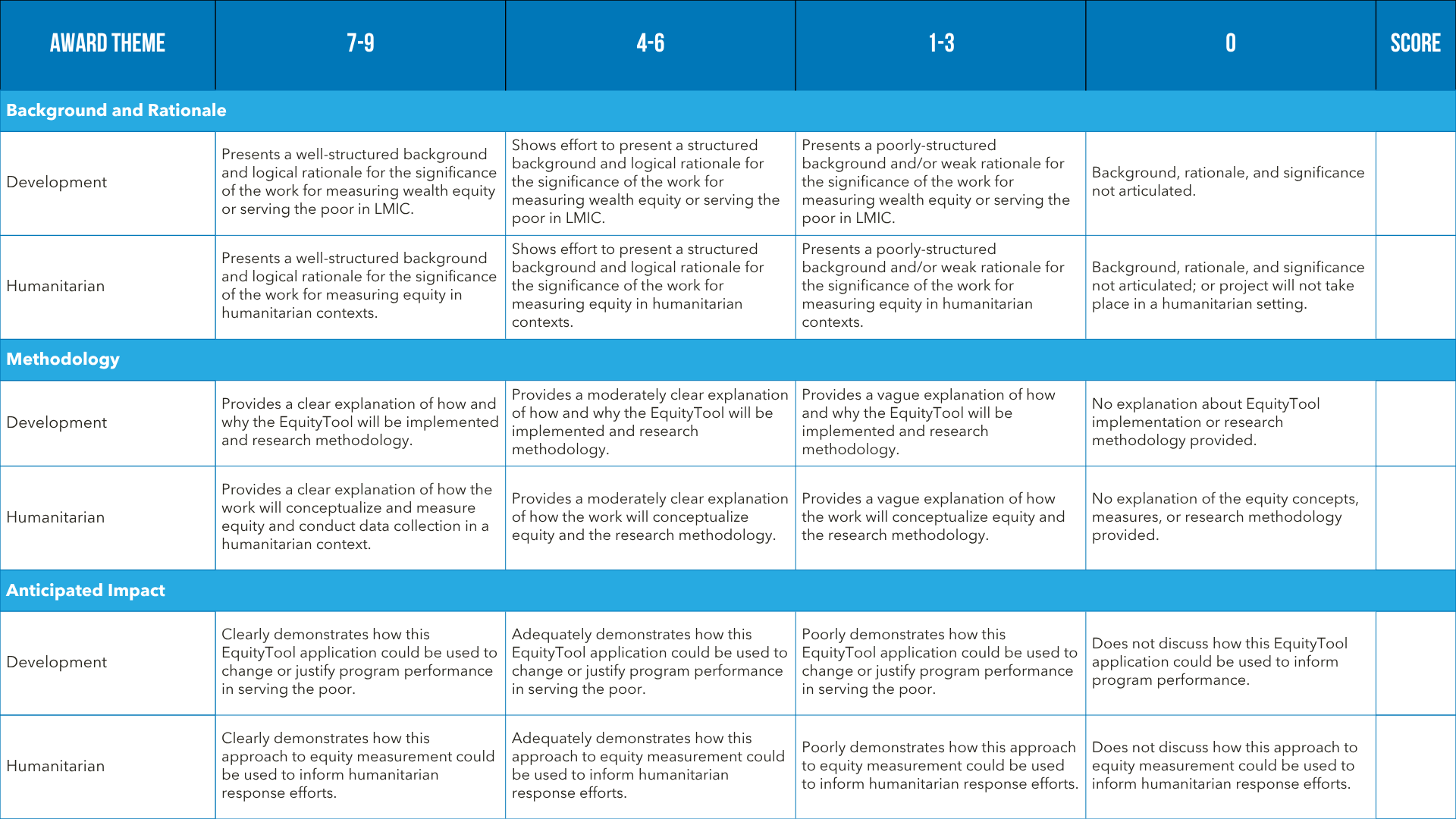
A panel of judges will use a blinded process to assess the background and rationale, methodology, and anticipated impact of the proposed work. See evaluation criteria. All three criteria are equally weighted. Judges affiliated with the project or institution will recuse themselves from assessment. Judges will select up to 10 finalists across both Award themes. M4M will support finalists to develop a 4-minute “lighting talk” presentation to deliver during Metrics for Management’s conference side session, where audience members will vote for the strongest proposed equity measurement projects; the top four nominees will be awarded prizes.

Selection Announcement

Finalists who will be invited for a lightning talk will be notified in October 2026, and must confirm the details of the person attending the HSR conference and Metrics for Management’s side session. 

Finalists will commit to developing their lightning talk presentation within the format M4M provides. Finalists and award winners also commit to participating in promotional activities related to your submission, such as a webinar, social media posts, written case study, interviews, and other activities as requested by M4M.

Evaluation criteria